
Leader
for a System Thinking Approach
This article introduces a practical framework for integrating
psychological safety, occupational safety,
emotional intelligence, and quality management
to achieve sustainable project performance and operational excellence.
The approach is based on Wellness Quality Management (WQM) and
QPMO – Quality Project Management Office, developed by
Dr. Emari at Stanford University.
Why Modern Organizations Need Human-Centered Performance Systems
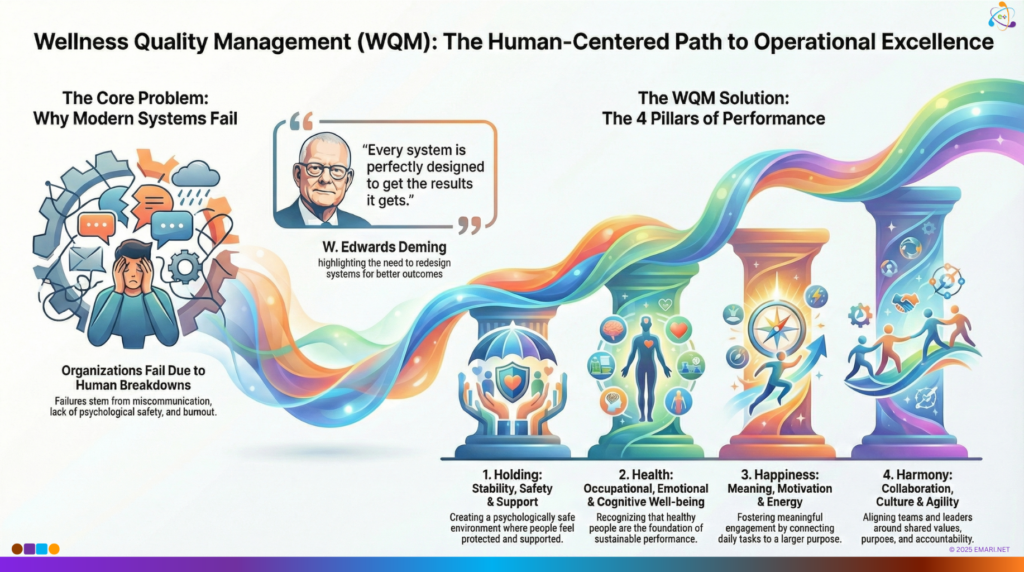
In today’s complex projects and operations, organizations rarely fail because of
technical gaps alone. They fail because of
human and organizational performance breakdowns:
miscommunication, lack of psychological safety, burnout, fear-based culture, weak coordination,
and blame-oriented problem solving.
As W. Edwards Deming famously said:
“Every system is perfectly designed to get the results it gets.”
If we want better results, we must design better systems—
systems that integrate:
- Human wellness and emotional resilience
- Psychological and occupational safety
- Emotional intelligence and collaborative leadership
- Quality management and organizational learning
This is the foundation of Wellness Quality Management (WQM)
and its application within the QPMO for
Strategic Leadership for Assurance and Compliance.
The EMARI System Thinking Model Behind WQM
Dr. Emari’s EMARI System Thinking (Engineering, Managing, and Reinventing Integration)
provides a structured method to transform individual and organizational performance.
It aligns with the work of Deming, Peter Senge, Daniel Goleman, Amy Edmondson,
Sidney Dekker, James Reason, and other thought leaders in quality and safety.
1. Engineering – Designing Human-Centered Systems
Engineering in EMARI focuses on the design of processes, workflows, expectations,
and controls that support people instead of constraining them.
Deming reminded leaders that
“Quality begins with the intent, which is fixed by management.”
Engineering in WQM ensures that intent is visible in clear procedures,
fit-for-purpose tools, and safe work methods.
2. Managing – Aligning People, Performance, and Purpose
Managing is about emotional intelligence, communication, motivation,
and responsibility. It is less about command and control, and more
about coaching, enabling, and empowering.
Daniel Goleman notes that
“Leaders become great not because of their power, but because of their ability to empower others.”
WQM turns this idea into daily management behaviors that build trust and ownership.
3. Reinventing Integration – Changing Culture Through Empathy & Learning
Reinventing Integration is where culture shifts from fear to learning.
It builds:
- Psychological safety
- Transparent communication
- Safe-to-fail experimentation
- Non-punitive incident and near-miss reporting
- Continuous improvement and organizational learning loops
Amy Edmondson observes that
“The best teams are not afraid to speak up, ask questions, or acknowledge mistakes.”
EMARI embeds this principle in the DNA of WQM.
The Four Pillars of WQM: The 4H Model
The 4H Model structures WQM as an integrated system for
human and organizational performance:
Holding, Health, Happiness, and Harmony.
1. Holding – Stability, Safety, and Support
Holding refers to creating a work environment where people feel
psychologically safe, emotionally supported, and operationally protected.
Safety expert Sidney Dekker reminds us that
“Safety is not the absence of accidents; it is the presence of defenses.”
Key Holding practices include:
- Non-punitive reporting and just culture
- Clear stop-work authority and speaking-up channels
- Regular supervisor presence and management walkarounds
- Active listening and respect for frontline expertise
2. Health – Occupational, Emotional, and Cognitive Well-being
Health in WQM covers three intertwined dimensions:
- Occupational health: physical safety, ergonomics, exposure control, fatigue management.
- Emotional health: resilience, stress management, EI-based communication.
- Cognitive health: focus, clarity, workload balance, and autonomy.
Peter Drucker famously said:
“People are the organization.”
Healthy people are therefore the foundation of sustainable performance.
3. Happiness – Meaning, Motivation, and Energy
Happiness in WQM is not superficial positivity;
it is meaningful engagement with work and purpose.
Simon Sinek argues that
“People don’t buy what you do; they buy why you do it.”
Happiness grows when individuals connect their personal “why” to the organization’s mission.
Key drivers of Happiness in WQM include:
- Role clarity and realistic expectations
- Strength-based assignments
- Recognition, appreciation, and growth opportunities
- Linking daily tasks to broader project and societal value
4. Harmony – Collaboration, Culture, and Organizational Agility
Harmony emerges when individuals, teams, and leadership
align around shared values, shared purpose, and shared accountability.
Peter Senge writes that
“When teams learn together, they become greater than the sum of their parts.”
Harmony practices in WQM include:
- Team charters and clear working agreements
- Cross-functional collaboration and interface management
- Conflict transformation rather than avoidance
- Daily huddles and learning reviews
- Lean value streams integrating safety and quality checkpoints
Seven Stages of Human & Organizational Development in WQM
WQM translates wellness and system thinking into seven practical stages of development
for individuals and organizations.
- Self-Awareness: understanding personal triggers, strengths,
biases, and behavior patterns. - Self-Management: regulating emotions, reactions, and impulses;
choosing responses aligned with values and safety. - Cognitive Clarity: developing critical thinking, sensemaking,
and informed decision-making under uncertainty. - Emotional Intelligence: building empathy, trust,
and influence through authentic communication. - Team Collaboration: practicing respect, shared problem solving,
and collective ownership of outcomes. - Organizational Alignment: connecting purpose, processes,
people, and performance measures. - Leadership for Operational Excellence: designing systems that enable
high performance without fear, blame, or burnout.
Applying WQM to Project Performance and Construction Safety
Within a QPMO environment, WQM brings together
psychological safety, occupational safety, and quality management
into a single, integrated approach to project performance.
Psychological Safety
- Workers can raise concerns without fear of retaliation.
- Stop-work authority is respected in practice, not just on paper.
- Incidents, near misses, and unsafe conditions are treated as data for learning.
Occupational Safety
- Risk recognition and pre-task planning are built into daily routines.
- Human factors and ergonomics are considered in procedure design.
- Defenses and barriers are proactively maintained and improved.
Quality Management
- Error-proofing (poka-yoke) and standardized work practices.
- Clear acceptance criteria and verification & validation checkpoints.
- Lessons learned feeding back into design, planning, and training.
Performance Management
- KPIs that include wellness and safety metrics, not just cost and schedule.
- Feedback loops that trigger system-level improvements, not individual blame.
- Data-driven decision making aligned with WQM values.
The result is a mature Quality Project Management Office (QPMO)
capable of delivering safe operations, high quality, low variability, strong
coordination, and faster, smarter decisions.
The WQM Leader: A Modern Definition of Empathetic Performance Leadership
The ideal leader in WQM is:
- Empathetic and emotionally intelligent
- Calm and present under pressure
- Collaborative and transparent
- Respectful and inclusive
- System-oriented rather than blame-oriented
Deming warned that
“A bad system will beat a good person every time.”
WQM leaders therefore focus on redesigning systems, not fixing people.
Conclusion: Wellness Is the New Foundation of Excellence
WQM reframes the conversation from narrow compliance and paperwork
to wellness, empowerment, collaboration, and performance.
It recognizes that:
- Excellence is a habit, not a one-time event (Aristotle).
- Culture consistently “eats strategy for breakfast” (Peter Drucker).
- Trust is the essential currency of high performance (Stephen Covey).
By integrating the 4H model—Holding, Health, Happiness, and Harmony—
with EMARI System Thinking and the QPMO framework, WQM offers a unified path toward:
- Healthy and engaged individuals
- Psychologically safe and agile teams
- High-reliability organizations
- Sustainable operational excellence
Wellness Quality Management is not a soft add-on; it is the strategic foundation
of human and organizational performance in the 21st century.