
Wellness Quality Management | WQM
Habit Power Through the 8P Pattern
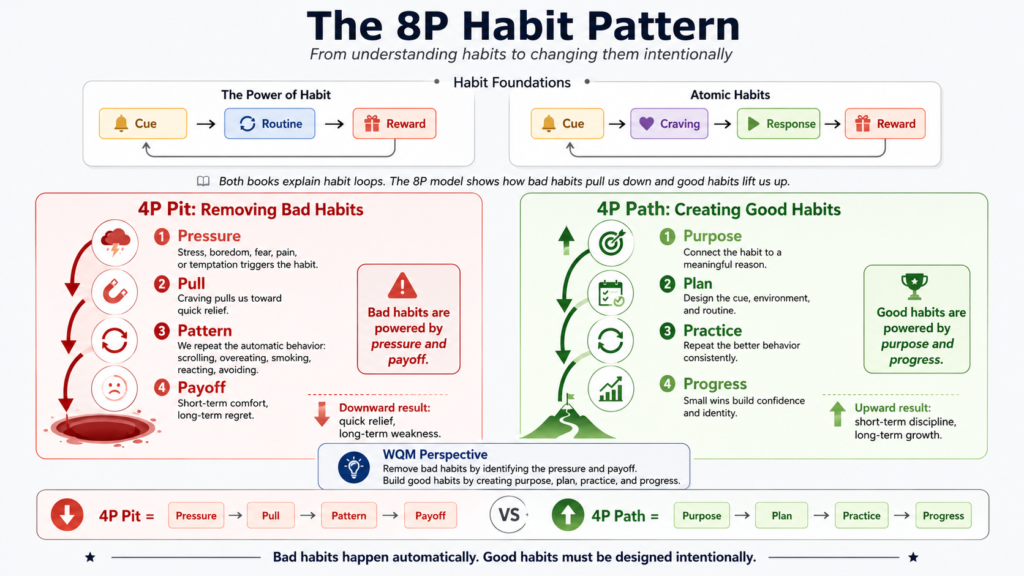
Comparing The Power of Habit and Atomic Habits,
then applying a WQM lens to remove bad habits and create good habits.
Two Books, Two Powerful Views of Habit Change
Both books help us understand habits, but they approach the subject from different angles.
The Power of Habit explains how habits work inside the brain, organizations,
companies, and communities. Atomic Habits focuses more on small daily improvements,
identity, environment design, and practical behavior change.
| Comparison Area | The Power of Habit Charles Duhigg | Atomic Habits James Clear |
|---|---|---|
| Main Focus | Explains how habits are formed through the habit loop: cue, routine, and reward. | Explains how small habits compound into major life changes over time. |
| Core Model | Cue → Routine → Reward | Cue → Craving → Response → Reward |
| Main Question | How do habits work, and why are they so powerful? | How can I design better habits and make improvement easier? |
| Best Use | Understanding personal habits, organizational habits, marketing habits, and social movements. | Building practical systems for daily improvement, discipline, and identity change. |
| Bad Habit Strategy | Identify the cue and reward, then replace the routine. | Make the bad habit invisible, unattractive, difficult, and unsatisfying. |
| Good Habit Strategy | Use craving, reward, belief, and keystone habits to create lasting change. | Make the good habit obvious, attractive, easy, and satisfying. |
| Leadership Value | Strong for understanding organizational behavior, culture, safety, and change management. | Strong for coaching, personal performance, team habits, and practical implementation. |
| WQM Connection | Helps us diagnose the habit system. | Helps us design the improvement system. |
The WQM Perspective
From a Wellness Quality Management perspective, habits are not only personal actions.
They are wellness systems. A bad habit usually forms when pressure creates a pull toward quick relief.
A good habit forms when purpose creates a plan for meaningful progress.
This is where the 8P Habit Pattern becomes useful. It separates habit power into two
directions:
4P Pit
4P Path
The 8P Habit Pattern
Bad Habits: The 4P Pit
Stress, boredom, pain, fear, or temptation triggers the habit.
Example: “I feel overwhelmed.”
The craving starts pulling you toward quick relief.
Example: “I need something now.”
You repeat the automatic behavior.
Example: Scrolling, overeating, smoking, avoiding, or reacting emotionally.
You get short-term relief, but not long-term growth.
Example: Comfort now, regret later.
Simple line:
Bad habits pull us into a pit through
Pressure, Pull, Pattern, and Payoff.
Good Habits: The 4P Path
You connect the habit to a meaningful reason.
Example: “I want better health, peace, and confidence.”
You design the cue, environment, and routine.
Example: Set clothes out for a morning walk.
You repeat the better behavior consistently.
Example: Walk, journal, pray, read, exercise, or prepare tomorrow’s priorities.
You feel growth, confidence, and identity change.
Example: “I am becoming disciplined.”
Simple line:
Good habits lift us onto a path through
Purpose, Plan, Practice, and Progress.
Side-by-Side WQM Habit Comparison
| Step | Removing Bad Habits: 4P Pit | Creating Good Habits: 4P Path |
|---|---|---|
| 1 | Pressure Notice what triggers the unhealthy habit: stress, fear, pain, boredom, conflict, or temptation. | Purpose Connect the new habit to a meaningful reason: health, faith, family, peace, growth, or leadership. |
| 2 | Pull Identify the craving. Ask: What am I really looking for — comfort, escape, control, attention, or relief? | Plan Design the habit before pressure arrives. Make the good choice easier and the bad choice harder. |
| 3 | Pattern Name the automatic routine. Do I scroll, snack, smoke, argue, delay, avoid, or emotionally react? | Practice Repeat a small positive action consistently. Keep it simple enough that it can survive a busy day. |
| 4 | Payoff Recognize the short-term reward and the long-term cost. The habit may comfort me now but weaken me later. | Progress Track small wins. Let visible progress create confidence, motivation, and a new identity. |
How to Use the 8P Model in Real Life
| WQM Question | Your Reflection |
|---|---|
| What pressure usually triggers my bad habit? | Example: stress, loneliness, fatigue, conflict, boredom, or fear. |
| What pull or craving do I feel? | Example: I want comfort, escape, control, connection, or quick relief. |
| What pattern do I repeat? | Example: I scroll, snack, complain, delay, avoid, smoke, or react. |
| What payoff keeps the habit alive? | Example: I feel better for a few minutes, but I lose energy, focus, or peace later. |
| What purpose can guide a better habit? | Example: I want to become healthier, calmer, more disciplined, and more present. |
| What plan can I prepare? | Example: Put my phone away, prepare healthy snacks, schedule a walk, or create a reminder. |
| What practice can I repeat? | Example: Ten minutes of walking, journaling, prayer, breathing, reading, or planning. |
| What progress will I celebrate? | Example: More energy, better mood, less regret, improved focus, and stronger self-respect. |
Book Club Talking Point
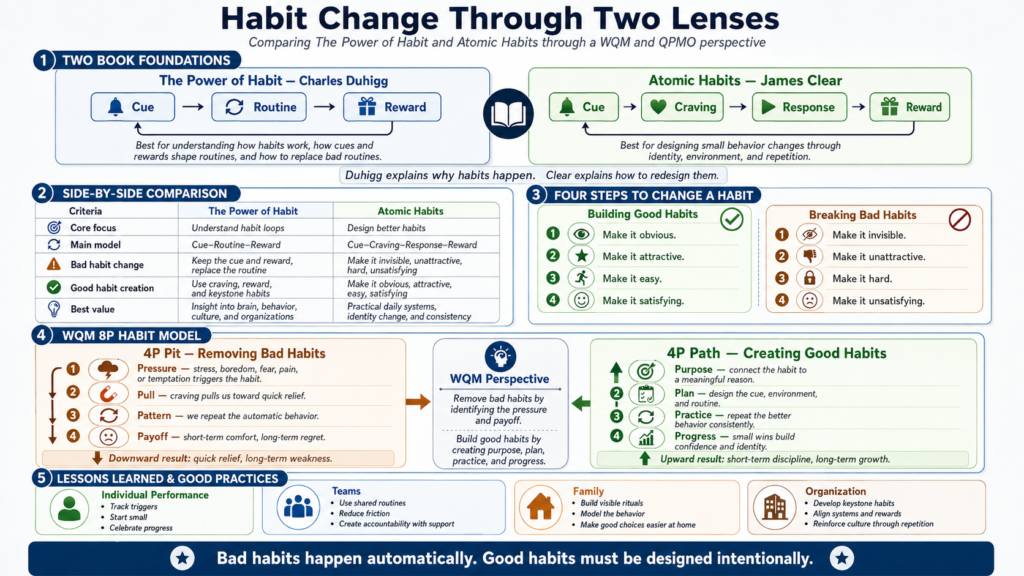
One way I connect these two books is that The Power of Habit helps us understand the habit loop,
while Atomic Habits helps us design better daily systems. From a WQM perspective, I would separate
bad habits and good habits into two different patterns. Bad habits often follow a 4P Pit:
Pressure, Pull, Pattern, and Payoff. Good habits need a 4P Path:
Purpose, Plan, Practice, and Progress. So for me, habit change is not only about willpower.
It is about understanding the system that pulls us down and designing a better system that lifts us up.
Final Takeaway
Bad habits usually happen automatically when pressure meets quick payoff.
Good habits are created intentionally when purpose becomes a plan, practice becomes consistent,
and progress becomes part of our identity.